Publication_Citizen Panel on Animal Welfare_Available Online_0109
Case
National Citizens’ Panel on Animal Welfare – Danes Advise the Danish Parliament
What should the future of Danish pig production look like if we balance animal welfare responsibilities with expectations regarding price and production? Through a national citizens’ panel, 36 representative Danes from across the country have developed 8 recommendations and 33 concrete initiatives for the Ministry of Nature and Animal Welfare and the Danish Parliament.
Background
Strengthening animal welfare is a political goal. Denmark is the world’s largest producer of pork per capita, and pork production is a central pillar of the Danish food industry as well as a time-honored part of Danish food culture. Improving animal welfare in future pork production requires striking a balance in our society between urban and rural areas, between consumer expectations and producers’ conditions in a global market, and between economic sustainability and ethical responsibility.
As part of the “Together for the Animals ” agreement, the Danish Parliament decided to establish a national citizens’ panel consisting of 36 citizens selected at random from across Denmark. The purpose was to give politicians insight into citizens’ everyday perspectives and priorities regarding a complex political issue.
We Do Democracy and the Democracyx Foundation together formed an independent third-party secretariat responsible for designing and implementing the process in accordance with the OECD’s principles for deliberative citizen engagement. We were responsible for designing, recruiting, vetting, and facilitating the citizen panel, as well as for ensuring the involvement of the broader public.
Task
The Citizens’ Panel was tasked with advising the Ministry of Nature and Animal Welfare and the Danish Parliament on how Denmark can improve animal welfare in future pig production.
The Citizens’ Panel’s core mission was: “ We need the Citizens’ Panel’s help to envision a future for Danish pig production that reconciles responsibility for animal welfare with expectations regarding the price and production of pigs.”
The Citizens’ Panel developed specific recommendations for animal welfare in future pig production. The result of this work was 1 vision, 8 overarching recommendations, and 33 initiatives for the future of pig farming.
In this way, the citizen panel also served as an effort to bring citizens closer to the preparatory work involved in the Danish Parliament’s political decision-making processes.
Solution
More than 10,000 citizens were invited, and 491 citizens from across the country and with diverse backgrounds signed up to participate in the citizen panel when the then Ministry of Agriculture, Food, and Fisheries issued the invitation. The 36 citizens were selected through a stratified random draw conducted by Statistics Denmark, ensuring that the panel reflected the Danish population based on the sociodemographic criteria of gender, age, and geography.
Over the course of more than four months, the citizens met during two weekend sessions and three online sessions. Along the way, the panel gained insights from a range of experts and professional advisors and engaged in dialogue with stakeholders representing various perspectives on animal welfare and pig production—including the Danish Pig Producers Association and the Danish Organic Farmers’ Association. Throughout the process, the members worked their way toward the core task of developing joint recommendations and initiatives. In total, the members spent over 32 hours in in-person and online meetings that took place outside of regular working hours.
To ensure that the panel received up-to-date and accurate information, an advisory group composed of experts in the field was established. The independent expert advisory group consisted of researchers Peter Sandøe, Mickey Gjerris, and Lene Juul Pedersen. In addition, a stakeholder monitoring group was established to ensure the involvement of the broader community; stakeholders were invited, among other things, to submit stakeholder comments—an invitation that 8 organizations accepted.
The process was organized in accordance with the OECD’s principles for deliberative processes, with a focus on, among other things, a clear mandate, transparency, independence, access to balanced information, and a clear commitment by the commissioning body to act on the recommendations.
Results
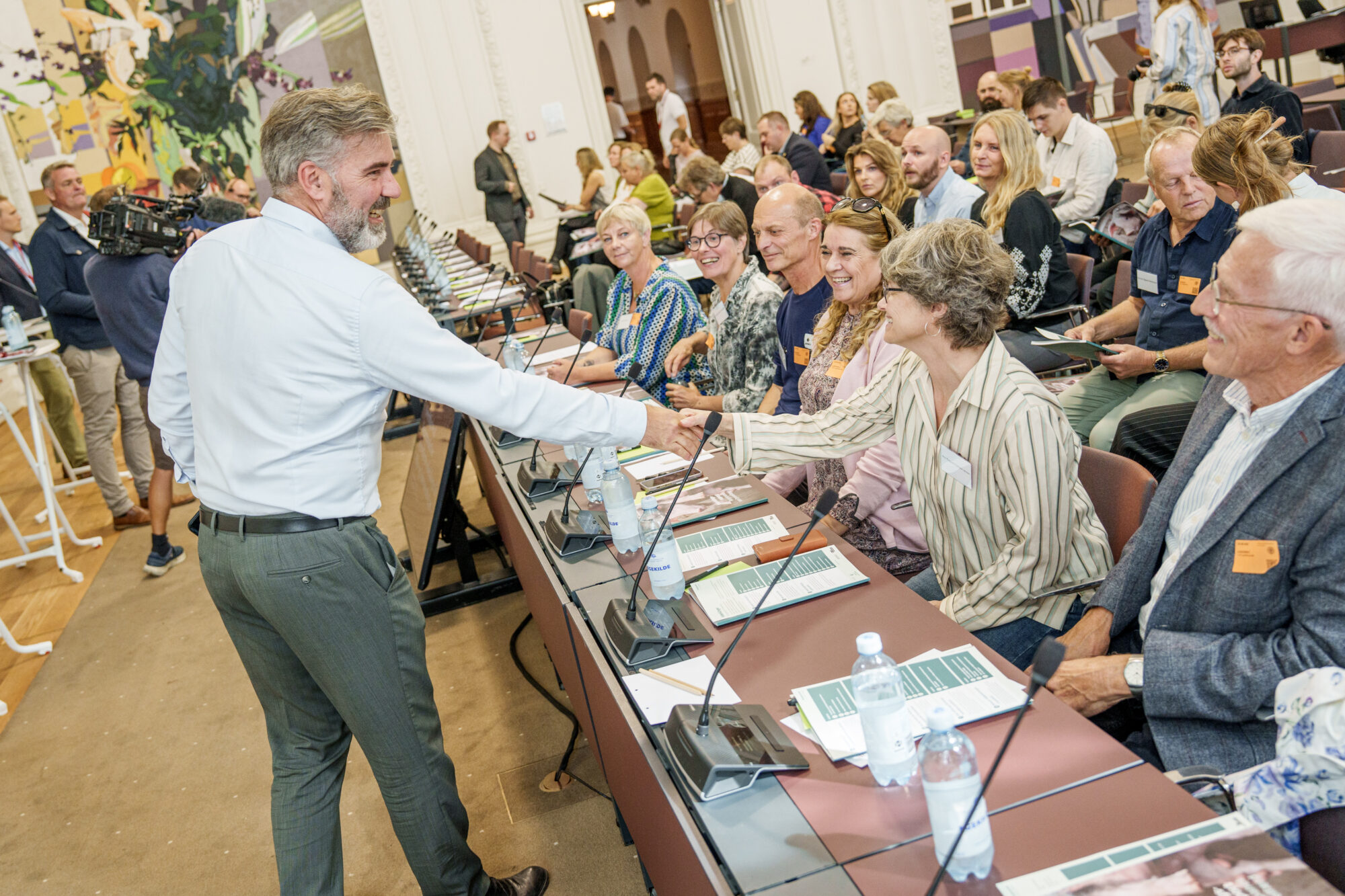
On September 2, 2026, the Citizens’ Panel presented its recommendation report to Christian Rabjerg Madsen, Minister of Nature and Animal Welfare, and 11 members of the Folketing’s Environment and Food Committee who were in attendance. The presentation took place in the Landsting Hall and provided an opportunity for politicians to engage in dialogue with citizens to understand the recommendations and the considerations behind them. Read the final recommendation report here
The 8 recommendations and 33 initiatives highlight, among other things:
- Significantly fewer pigs in Danish production.
- More space and better living conditions for pigs.
- Stronger oversight of animal welfare and more independent research.
- Support and training for producers so the industry can transition to higher animal welfare standards.
- A clear recommendation that, if the rules are not changed, current conventional pig production should be phased out.
The 33 initiatives received an average of 97% support from the panel members, and no members chose to submit a dissenting opinion. This shows that citizens with different perspectives can find common priorities when they are given the time, knowledge, and opportunity to listen to one another.
At the same time, the process points to broader democratic potential: The citizens’ panel is a new example of how the Danish Parliament and the Government can involve a representative cross-section of the population—as experts in everyday life—in their work on complex national policy issues.
The presentation of the recommendations marks a turning point. With these recommendations, the work is being handed over, and citizens’ perspectives are being incorporated into the ongoing political process.
As part of the mandate to follow up on the work of the citizens’ panel, the Animal Ethics Council must prepare an assessment of the recommendations within three months, while the Agency for Green Space Conversion and the Aquatic Environment must evaluate the recommendations. This is intended to support further work on the recommendations.
The ministry is required to address the recommendations, including ensuring that they are discussed among the parties to the agreement and made available to relevant committees and the Folketing. Six months after the handover, the Ministry must provide the public with an update on how the recommendations have been assessed, evaluated, and discussed or implemented politically. Within 24 months, another update will follow on how the recommendations have been implemented politically.
In this way, citizens’ recommendations are not merely submitted, but become part of an ongoing dialogue about the future of animal welfare—with a commitment to revisit them with those who helped shape them.
Facts
- Title: National Citizen Panel on Animal Welfare
- Period: January through September 2026
- Commissioning Authority: Ministry of Nature and Animal Welfare (at the start of the project, the Ministry of Agriculture, Food, and Fisheries)
- Number of members: 36 citizens selected to be representative of the entire population of Denmark
- Method: Deliberative citizen panel
- Deliverables: 1 recommendation report, including an overarching vision, the current problem, values for future animal welfare, as well as 8 recommendations and 33 initiatives.
Photo credit: The Danish Parliament
Do you want to
know more?
