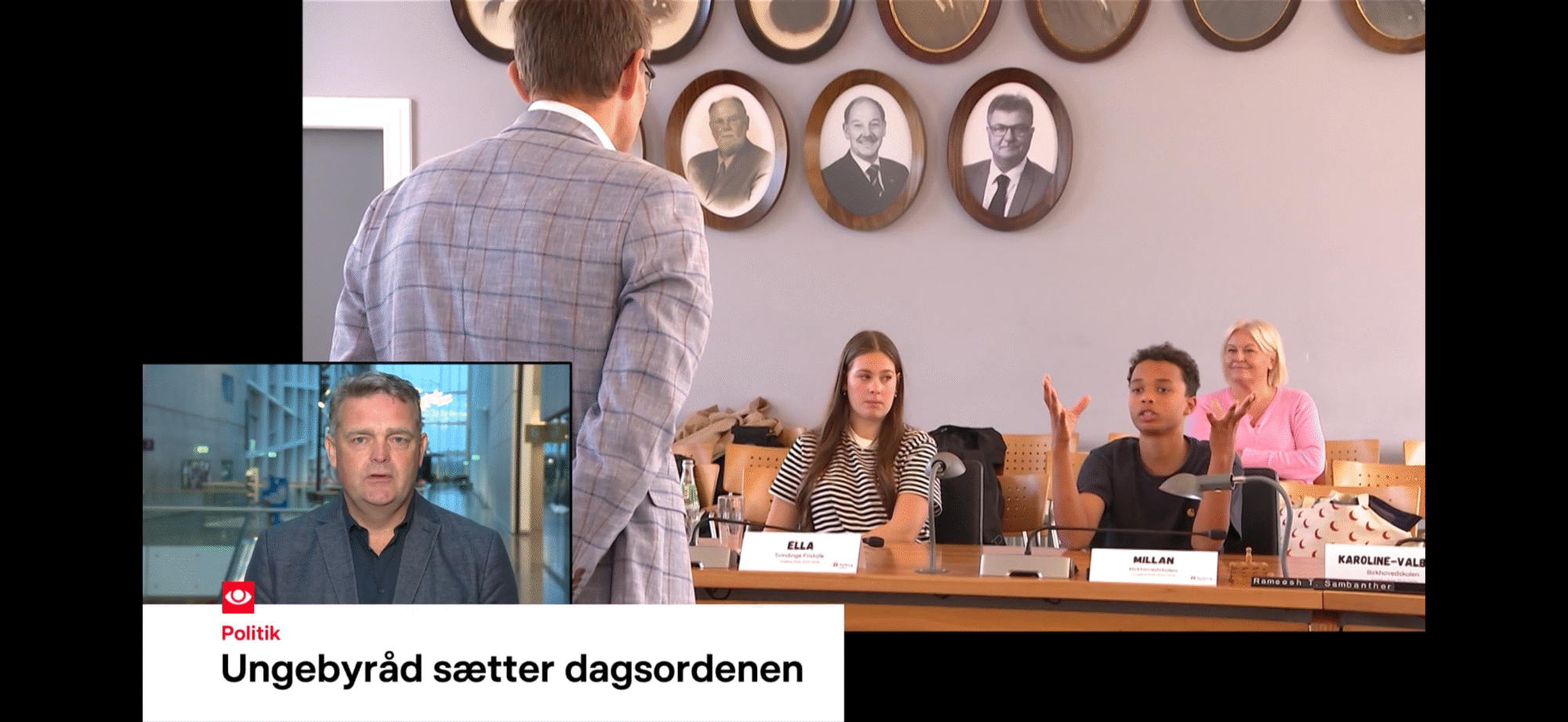
As background for DR’s focus on youth councils, we have gathered knowledge about youth councils and youth councils in Denmark. Municipal youth councils first saw the light in the 1960s and have since developed significantly since the 1980s, when youth councils were first established in the wake of the UN’s International Year of Youth. The number of youth councils is on the rise and today around two-thirds of the country’s municipalities have an explicit youth council.
The young generation today is more active than the previous generation, but not very interested in party political participation. Therefore, it is essential to test other ways of doing so. But in many places, youth councils have had a hard time succeeding – and have been closed again. The question is whether this is the right way to ensure young people’s place in decision-making processes. And whether there were other forms of participation that moved more – e.g. youth members of boards, young citizen assemblies – or overrepresented youth seats in ordinary city councils, direct influence and citizen budgets, as well as free funds for entrepreneurship and activism on their own terms.
What are the crucial things to consider
- Is there a difference between youth councils and municipal youth councils?
There is no substantive difference – there are many youth councils in Denmark, they do pretty much the same as the youth councils and have the same mandate.
- Why make another “kids’ table”?
It is so important for the development of democracy that we ensure better representation than the classic electoral representative formats can support. This includes youth representation, because getting many voices into the room and ensuring reflection in democratic bodies ensures more ownership, legitimacy and better political solutions. But why not just give young people reserved seats and vote directly in city councils? In newer democracies such as North Macedonia, for example, there is good experience of creating generation quotas in city councils to retain young people.
- Young people with often the same background
We know from many participation formats that young people are hard to get to come – and that it is often young people with the same background who participate, such as those active in associations, politically active or from existing youth forums. For individual young people, it is often the first time they participate in a youth council format and crucial for their democratic confidence – but if there are no resources to recruit beyond the channels you already have for young people, there is a risk that the youth council does not represent the many. It’s good to see the places in the country where solid efforts have been made to ensure more and better diversification in the profiles that are recruited. In Borgersamlingen Ung-indflydelse(https://www.wedodemocracy.dk/ung-indflydelse-vaer-med-i-et-faellesskab-der-goer-en-forskel/), Nyborg Municipality (together with 4 other municipalities and We Do Democracy) has made stratified drawings that have a significantly greater spread that would be obvious to use as a method for youth councils than the methods used today. The youth council will meet physically for the first time this weekend – could be exciting to make a feature about.
- The quality of youth council work – it requires support
It requires good service to ensure influence and policy impact on agendas – just like the regular city councils. In many places, what comes out of youth councils is not useful – apart from the good process effect that young people achieve by being part of a community. But without influence and feedback mechanisms on why city councils subsequently choose to go – or not to go – with the young people’s recommendations, they lose legitimacy and interest. If you don’t have the resources to support this, it’s better to create other formats, such as gathering young people in local communities of action in everyday life.
- Mandate and influence – tighten up
Youth councils work really well in places where there is a solid, transparent and committed mandate from the municipality and city council, such as the Copenhagen Youth Council, which has a mandate to make proposals to the city council and in the latest budget agreement has received key issues such as better sex education, free menstrual pads, measures against racism and better cycling conditions. In many places, however, these are loose and more process-oriented mandates.
Facts:
- How many municipalities have youth councils?
There are around 60 local youth councils and youth houses in Denmark of which 47 are members of the Network of Youth Councils (2021):
https://www.tuborgfondet.dk/bevilling-skal-booste-unges-indflydelse-i-kommunerne/
- What do youth councils have a mandate/influence on?
The overall purpose of the Youth Council is to be a voice for young people so that their voices are heard in the city council and committees, so that they can influence decision-making processes.
The mandate varies, but typically includes:
- Consultation rights in matters concerning children and young people (e.g. school, leisure, culture, transport, environment)
- Right to submit proposals and initiatives to the city council or relevant committees
- Participation in the development of municipal strategies for young people
- Sparring and dialog with municipal politicians and officials
In six of the country’s municipalities (from 2026), the Youth Council has the right to submit proposals directly to the city council or relevant political committees. From 2025, Aalborg Youth Council can send four proposals annually to Aalborg City Council, which the council is obliged to consider(https://www.aalborg.dk/mit-liv/ung/fritid-og-indflydelse/aalborg-ungebyraad). Similarly, the Youth Council KBH can request four proposals to be considered politically by the Copenhagen City Council every year. In addition to the youth council’s four proposals, the council is a consultation partner in a number of areas: https://www.kk.dk/politik/lokaludvalg-saerlige-udvalg-raad-og-naevn/raad/ungeraad-kbh
The mandate can also include financial control over a fixed budget for their own projects; the majority of councils have control over their own budget for activities in the style of, for example, Viborg, where youth councils have funds to create/support projects that make youth life in Viborg great: https://viborgungdomsraad.dk/.
- What is the impact of youth councils?
There are no nationwide quantitative evaluations, but local evaluations and experiences indicate that youth councils are most effective where they have a clear mandate, resources and political backing.
In general, it can be said that youth councils strengthen young people’s understanding of democracy and engagement.
Municipalities with larger budgets and closer collaboration with the city council experience greater engagement and results. Innovative methods such as digital elections and SMS voting have been tried, but no significant impact has been documented using new digital methods alone.(https://nau.dk/wp-content/uploads/2020/05/Erfaringer-fra-ungdomsr%C3%A5d7.pdf)
Challenges include member retention and the feeling of real influence. Young people lose interest/enthusiasm if they don’t feel they have a say/that it has a real impact(https://www.trivselskommissionen.dk/-/media/filer/trivselskommissionen/250224-trivselskommissionens-boerne–og-ungepanel-inddragelsesgang-1.pdf)
- How do youth councils coexist with other decision-making bodies?
Youth councils act as a link between young people and city councils and often collaborate with relevant committees. Unlike councils for the elderly, which are required by law, youth councils are not guaranteed by law, making their existence and influence more vulnerable to political and economic priorities(https://www.altinget.dk/civilsamfund/artikel/unge-hvorfor-findes-der-en-lov-om-aeldreraad-men-ingen-lov-om-ungeraad)
In several municipalities, the youth council is anchored in the youth school or has a permanent contact person in the administration, which ensures coordination and knowledge sharing(https://aarhus.dk/demokrati/politik/raad-og-naevn/specifikke-maalgrupper/boerne-og-ungebyraadet + https://ungdomsskoleforeningen.dk/wp-content/uploads/2024/04/Inspirationskatalog-demokrati-2024.pdf)
Collaboration with student councils and community councils is widespread and often serves as a recruitment channel (https://nau.dk/wp-content/uploads/2024/06/Publikation-Sadan-far-du-indflydelse-i-din-kommune.pdf)
- Where do young people come from/who signs up for youth councils?
Members are typically elected democratically among young people in the municipality, often through elections at schools, youth programs or online platforms. The age group typically ranges from 13 to 24 years. Recruitment is typically done through school visits, collaboration with student councils, via secondary schools, online elections and targeted campaigns. It requires higher democratic self-confidence to join and the feeling that democracy is “for you” to join and therefore a particular segment of youth tends to be more represented (generally in associations, youth parties and thus also here(https://www.trivselskommissionen.dk/-/media/filer/trivselskommissionen/250224-trivselskommissionens-boerne–og-ungepanel-inddragelsesgang-1.pdf + https://frivillighed.dk/analyser/artikler/nyt-forskningsprojekt-styrker-organisationers-arbejde-med-rekruttering-og). Several address this by doing SoMe campaigns and events such as communal dining, to reach a wider audience – or make less binding memberships(https://nau.dk/wp-content/uploads/2024/03/Faa-flere-med-i-faellesskabet.pdf).
Participation is highest where young people feel their voice matters and where the youth council offers meaningful roles and responsibilities(https://www.ms.dk/sites/default/files/ungepublikationer/publikationer/2023/ms_kbh-ungeraadsmanual.pdf).
We have not included other collaboration formats with young people or the use of student councils in this background note.
Main sources:
NAU, “How to get influence in your municipality”, 2024:
https://nau.dk/wp-content/uploads/2024/06/Publikation-Sadan-far-du-indflydelse-i-din-kommune.pdf
NAU, “Bringing more people into the community”, 2024:
https://nau.dk/wp-content/uploads/2024/03/Faa-flere-med-i-faellesskabet.pdf
Ungdomsskoleforeningen, “Inspiration catalog democracy”, 2024:
https://ungdomsskoleforeningen.dk/wp-content/uploads/2024/04/Inspirationskatalog-demokrati-2024.pdf
Mellemfolkeligt Samvirke and Copenhagen Youth School, Youth Council Manual, 2022:
https://www.ms.dk/sites/default/files/ungepublikationer/publikationer/2023/ms_kbh-ungeraadsmanual.pdf